
Sometimes, I hate being called cute. It’s not necessarily a bad thing, though it can be unnerving. It’s this shift in people’s eyes when they meet me: “Oh! You’re cute.” Almost cooing at me, like I’m a doll.
I work as a dishwasher on the weekends. It’s a good job. It pays the bills, relatively stress-free, and I like my co-workers… for the most part. One co-worker in particular had become a source of anxiety for me. She likes to bombard me with compliments such as: “You’re so cool!” when I’m putting ketchup ramekins away or “You’re so beautiful!” when I look visibly sick of being at this restaurant, dissociated.
She’s not saying ‘cute’, but this elicits a similar reaction in me. I’m a dishwasher for goodness’ sake. My shirt is soggy, my hair is frizzy, and I smell like garlic and onions. To each their own, I guess, but there’s just something amiss… we’ve barely had an engaging conversation. Her compliments feel hollow and off-putting; it just doesn’t resonate coming from essentially a stranger. Especially one with a half-naked anime girl sticker displayed on her water bottle.
I recently finished a series called “Mr. and Mrs. Smith” created by Donald Glover and Francesca Sloane. This article summarizes the show as follows, “a nameless agency matches two directionless spies to create a married assassin team that are sent on missions.” It follows the developing relationship between two characters, John Smith, played by Donald Glover, and Jane Smith, played by Maya Erskine. Being a fan of romantic dramadies and surrounding genres, it kept me fairly entertained playing in the background as I worked on a project.
In the aforementioned article, titled “Donald Glover’s Asian women fetish isn’t just disturbing, it could have dangerous implications,” (Nardos Haile) Haile addresses a scene where Asian women are the punchline:
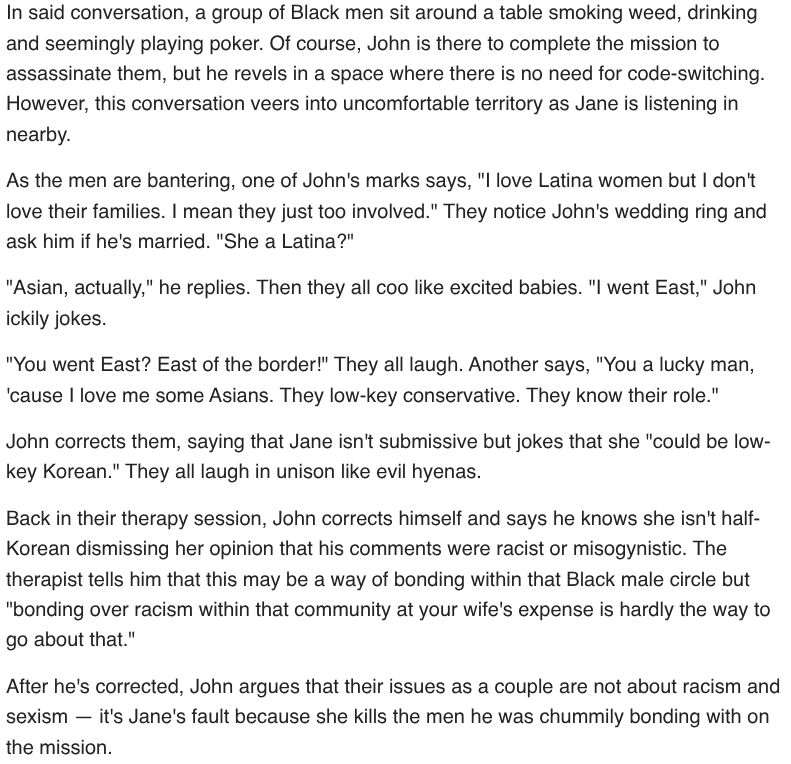
I suppose it’s true that these kinds of conversations do happen in real life, though I question the necessity of this scene. It doesn’t add much to the storyline and Jane’s emotions about this racist conversation get talked over; the therapist corrects John, but the dialogue quickly moves on to the next issue. It’s being treated as one of the many minute issues they are having as a couple. It leaves a bad taste in my mouth, given Glover’s history of objectifying Asian women.
Starting from his first label release “Camp” where he pens multiple strange (and lazy) lyrics referring to Asian girls:
“You See Me“
Forget these white girls
I need some variation
Especially if she very Asian
“Kids (Keep Up)“
Finding you is like finding Asians I hate
But they say I got a fetish, nah, I’m skipping all of it
Black or white girls come with a set of politics
That’s all I was saying
“The Backpackers“
I got a girl on my arm dude, show respect
Something crazy and Asian, Virginia Tech
Glover writes about his preference for Asian women in a way that is generalizing—that Asian women are pretty trophies that don’t have strong opinions. In the second example, he uses “Asian” like a positive adjective; it’s a compliment to this person he’s talking to. He’s comparing this genuine and rare connection to the rarity of finding Asians he hates. How… romantic? Again in the third example, the two attributes he describes this girl having is that she’s crazy and Asian. So much of a juxtaposition that he then references the deadliest school shooting that happened in 2007 at Virginia Tech, where the perpetrator was Korean.
Glover has a lot of lyrics in this album similar to that, implementing shock value as a device to showcase his crude wordplay (and racism).
“L.E.S.”
Yellow-911-Persian girl-in-the-back car
Going back to that scene from “Mr. and Mrs. Smith,” the men list off different Asian ethnicities as a shorthand for what kind of personality these types of women have. Japanese women are submissive, Filipino women are rambunctious, etc. This is what is implied by the laughter following after each “joke,” the joke being Asian women. I must clarify, though, Donald Glover is not credited as a writer for this episode, however, hearing these lyrics from “Camp” provides some ugly insight into how Asian women are perceived in the west and how that bleeds into our media.
Another article from 2011, titled “Does Childish Gambino Have an Asian Problem?” (Victoria Yue), Yue writes about each of the lyrics listed above (and more) and the harmful implications they have. She concludes the article by relating to Glover in feeling like an outsider in terms of one’s racial identity; in Glover’s case, being the one nerdy black kid who grew up in Georgia.
Yue questions why Asians are such a casual punchline for Glover when he finds himself in a similar marginalization of not being able to fit comfortably in a box; tired of the stereotypes and what it means to be a “real” black person. She speculates that “perhaps objectifying Asians, women, and Asian women in his lyrics is the only way he can feel the measure of power and control that he believes he should have but doesn’t receive in real life.”
I think there is some truth to this statement, though I’m going to pivot away from Donald Glover. In the episode with that aforementioned scene, titled “Couples Therapy (Naked & Afraid),” the show is at its climax. At this turning point, John and Jane seek to relieve tensions at couple’s therapy. Issues that they had with one another were building up and being expressed in slights and annoyances towards each other. During a camping trip for a mission, it all crescendos into a big argument where they’re yelling at each other. Jane brings up his “obsession” with his mom and John becomes defensive. He explains why he’s so close to his mom and insults her lacking relationship with her father, as well as her cold and apathetic demeanor. This goes on for about 40 seconds. Jane doesn’t say anything in return except for one question: “Who is your emergency contact?” John looks at her in confusion, so she repeats herself, then he says that his mom is. Jane confesses, “You’re mine,” before tearfully walking away.
With any issue that Jane has, she doesn’t get as much screentime to really voice her thoughts and emotions. Throughout this episode, the bulk of her dialogue is her explaining a situation to the therapist or getting caught up in an argument with John. She doesn’t get to clarify her own perspective to John the same way that he does to her.
Whether it was intentional or not, this writing mimics the real world in the sense that women’s issues aren’t taken as seriously as men’s issues. When Jane points out John’s racism, he switches it around on her and says that wasn’t the point of the bigger argument. When John points out Jane’s inability to understand his relationship with his mother, she takes it in… and so do we, as the audience watching.
Being Asian-American and femme-presenting, misogyny is expressed to me in an infantilizing, sometimes pedophilic way. I’m short and I guess I look young, so people think I am a child.
Last year, when I was 21 years old, I was spending my afternoon writing on a park bench. A maintenance truck rolls up next to me and the guy inside calls for my attention.
“Hey!” he says, smiling. “Are you okay?”
“Yes, I’m alright,” I reply.
He continues, “Aren’t you supposed to be in school?”
Confused, I say, “No?”
Then he offers, “I can give you a ride.” He looks at me eagerly. Suddenly, his grin is colored something sour and nasty.
I pause for a moment. I tell him, “I drove here. I’m an adult.” His eyebrows lift up in surprise.
“Aw, okay.” He chuckles and then drives away, leaving me with a twisting knot in my stomach. Was he trying to kidnap me?
Things like that just happen. Pedophiles pursue me, people assume I’m dumb and naive, and my kindness/politeness is perceived as weakness. I tell an older white man I’m Filipino and there’s a 40% chance that he will immediately tell me his wife is Filipino or some kind of Asian, as if we’re all the same. I don’t care!!! I don’t know you!!! My directness doesn’t hold any gravity for these kinds of people either.
Once at a cafe, I was in line with my friend, who is Korean. The woman in front of us turns around, sees us, and asks me excitedly, “Are you Japanese?” I don’t look Japanese in the slightest.
I tell her, “No. Don’t ask me that.” She laughs it off then goes about her day. What about that was funny? My friend and I joked later on that day that she must have seen the common denominator between us, our homelands having been colonized by Japan.
My previous boss asked me if I was of legal age to drink. I said yes. She replies, “Oh my gosh, you look so much younger.” She giggles and sees the grimace on my face. “Don’t worry, though, it’s a compliment.”
I never know what to say when people tell me these things. They move on before I say anything else, and when I do say something, they think I’m being silly. I often find myself needing to prove to certain people that I’m an adult with autonomy. It’s hard to explain what’s wrong with these kinds of “compliments” because people get defensive when I say it makes me uncomfortable, as if I’m in the wrong for bringing it to their attention.
When I finally confronted my co-worker about the excessive compliments, I don’t think she understood me fully. I told her, “Listen, I’m transmasc, but I’m perceived as an Asian girl. I’m not saying that this is what this situation is, but because of that perception, I’ve been the subject of fetishization and unwarranted sexual advances.” I told her to think about why she assumed I would be okay with being called bebe and being complimented in this manner. We aren’t close, we’re just co-workers. It makes me feel uncomfortable and this is the reason why; I want to start a conversation about this.
Hearing this, she then asks me, “What pronouns do you use?” I say he/him and she/her.
She proceeded to explain why she was complimenting me, like I asked. She said that it wasn’t sexual at all and that she truly does believe I’m beautiful and cool, though she admitted that she noticed that it wasn’t well-received at times.
She apologized to me by saying the compliments that made me uncomfortable in the first place. In my head, I’m thinking what about me? I know I’m beautiful and cool, but this chick barely knows me so that’s why it’s weird. What’s she gaining from this?
Every conversation we’ve had, it was mostly her talking. I’m the only Asian ‘girl’ here. That’s basically all that she knows about me. I wasn’t able to explain to her that I’m not bothered by the words, but by what in the world the intent was, which is why I mentioned my experience as an Asian living in the US. She was already getting defensive, so I let it go. The next day I worked, she looked sullen and avoided eye contact with me. She missed my point completely, which annoyed me, but I enjoyed the silence nonetheless.
Oh well! I’m glad that I said something.
Over time, as I accumulate these odd experiences, I’ve learned to set firm boundaries and keep an eye out for things like a half-naked anime girl sticker. It may seem trivial, but it really is that deep. This sticker had stuck in the back of my mind as this co-worker flirted with me. I didn’t shut it down immediately, I thought my lack of reciprocation would be enough. Instead, it was taken as a means to keep going. I should have said something earlier, but I probably would’ve gotten the same reaction. Maybe I shouldn’t have mentioned my race and just said she made me uncomfortable. But if she was trying to be my friend, and, I assume, trying to get to know me, she should know that these are the things that I think and talk about. She was pinning all of these positive adjectives on me and expecting me to like it. The rejection was a surprise. WHY?
That’s just how the world is. All these issues remain prevalent in casual conversation and in our media. It’s annoying and intruding. It can feel never-ending. Over again, I will have to deal with people underestimating me, and a lot of the time, I let it happen without saying anything. I asked for advice from a trusted co-worker before talking to the other one. He told me, “Remember that you always have the right to say something back. No one can take that away from you.”
If I hadn’t addressed this situation with my co-worker, it would have kept happening, and I would have constantly felt anxious anticipating her comments. But I did address it and things changed! Conversation is a powerful tool for us social creatures. It’s important to use your voice where you can; to be courageous and express. Be open! Have discourse! That’s how things get moving. I have my story and a means to share it. I have my perspective and the ability to learn.
So do you.
 Pajolo Cam
say something!